


Why Visit Mandrare River Camp?
Nestled beneath towering tamarind trees along the banks of the Mandrare River, Mandrare River Camp offers an unforgettable safari experience in one of Madagascar’s most extraordinary and least-visited landscapes. Located in the remote southwest of the island, this intimate tented camp provides access to the surreal spiny forests of the Mandrare Basin — a unique ecosystem found nowhere else on earth.
Combining rare wildlife encounters, cultural immersion, and spectacular scenery, Mandrare River Camp is a highlight of any Madagascar safari.

Getting There
The most efficient way to reach the camp is via a scheduled charter flight from Antananarivo directly to the camp’s private airstrip, which operates on selected days of the week. This scenic two-hour flight offers a far more comfortable option than the alternative route via Fort Dauphin, which involves a commercial flight followed by a lengthy road transfer.
Due to Madagascar’s remote geography and limited infrastructure, air access plays an important role in making this remarkable destination accessible.
The Camp Experience
Mandrare River Camp is designed in classic safari style, blending comfort with a strong connection to the surrounding wilderness. The camp features just nine spacious tented suites, each positioned on wooden decks with sweeping views of the river.
Each tent offers:
- A large bedroom with mosquito netting and cooling fan
- Ensuite bathroom with shower, basin, and toilet
- A private viewing deck with seating area
- Charging points for cameras and devices
The camp’s central area includes a welcoming lounge, dining space, and a secluded swimming pool — perfect for relaxing between activities. Wi-Fi is available in the main area, allowing guests to stay connected while enjoying the remote setting.


Wildlife & Landscapes
The main attraction of this region is the extraordinary spiny forest — an ancient and fragile ecosystem characterised by towering “octopus trees,” baobabs, and surreal plant formations.
This unique habitat supports an impressive array of endemic wildlife, including:
- Verreaux’s sifaka, famous for its distinctive “dancing” movement
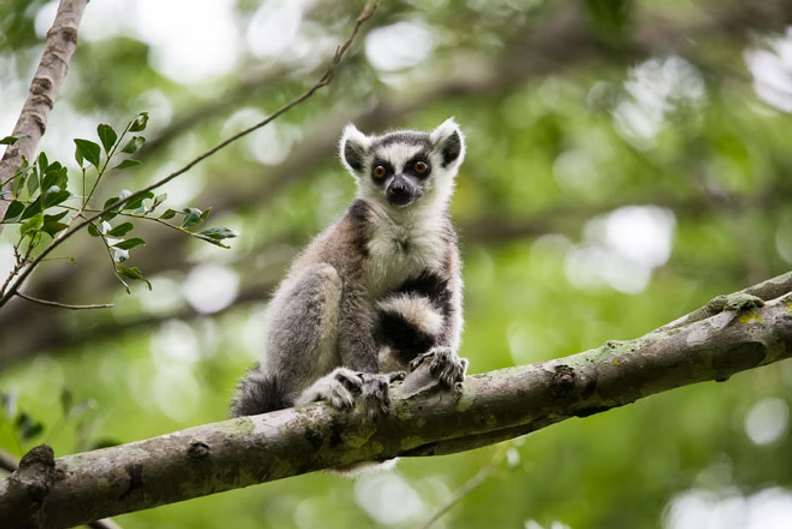
- Ring-tailed lemurs and several nocturnal lemur species
- Radiated tortoises, one of the longest-lived reptiles
- Numerous reptiles and chameleons
Unlike many destinations, Madagascar has no dangerous snakes, adding to the comfort of exploring the wilderness on foot.

Activities & Experiences
A stay at Mandrare River Camp offers a diverse range of wildlife, cultural, and scenic experiences.
Wildlife Exploration
Guided excursions into spiny and gallery forests provide opportunities to track lemurs, observe birdlife, and learn about this unique ecosystem.
Night Walks
Evening excursions reveal the fascinating nocturnal wildlife of the forest, including mouse lemurs and other rare species.
Cultural Encounters
Guests can visit local Tandroy communities, markets, and schools, gaining insight into traditional lifestyles and the deep cultural connections to the landscape.
Scenic Experiences
Highlights include sundowners among ancient baobab trees and visits to the saltwater lake of Lac Anony, home to flamingos and other birdlife.
Conservation & Community
Mandrare River Camp plays an important role in protecting the remaining areas of spiny forest in partnership with conservation organisations and local communities. Sacred forest sites surrounding ancestral tombs are carefully preserved, reflecting the strong cultural values that help protect this fragile environment.

We think this foreword by Sir David Attenborough really captures what you can expect…
‘The Spiny Forest of Madagascar is truly astonishing. Parts are dominated by swaying ten-metre-tall vegetable pillars, studded with lines of tiny coin-shaped leaves alternating with others of ferocious thorns. They have an improbable, slightly crazy appearance to anyone unfamiliar with them, but the landscape they create becomes almost surreal when a pure white furry animal that looks something like a monkey but is empathically not one, suddenly peers around one of these pillars to gaze at you with topaz eyes- and then leaps away, bouncing from pillar to pillar, its long white furry tail trailing behind it. Why it does not rip the soles of its feet and the palms of its hands to shreds, I still cannot understand.
Among the tangle of thorns there are, occasionally, huge trees. Some of these too, seem to come from another world. They have immense bloated trunks within which they store water, and each has its own very individual shape. This makes them valuable landmarks when you have got lost trying to find a way through the spiny tangled undergrowth.
The lemurs, for many, will be a major attraction of this amazing country and in additional to the white leapers there are several other species, some no bigger than rabbits, others as small as mice. As in most arid lands, there are numerous reptiles. Madagascar, as a whole has more species of chameleon than anywhere else in the world and the spiny forest is particularly rich in these and other lizards. Spectacular tortoises, their shells handsomely patterned with yellow radiating stripes, plod across the red sandy ground. There are not many birds, the land is too hot and dry to support great numbers, but those you do spot are likely to include several species that are found nowhere else but in Madagascar.
Much of this strange forest has now been cut down and replaced by farmland, savannah and uniform rows of sisal plants, the leaves of which are used to produce industrial fibre. In some areas the uniform rows stretch in all directions as far as the eye can see. That makes the patches of spiny forest that have so far survived all the more precious. David Attenborough.’
Credit: Foreword by Sir David Attenborough, from the book ‘Life Amongst The Thorns, Biodiversity & conservation of Madagascar’s Spiny Forest’.Authors: Louise Jasper & Charlie Gardner
